Wednesday, 30 May 2012

Punk Is Dead


A very wise Canadian once wrote that 'fish don't know water exists until they're beached. Without anti-environments, all environments are invisible. The role of the artist is to create anti-environments as a means of perception and adjustment' (Marshall McLuhanCulture as Business, 1970). Back in the mid-1970s when the world was young enough to believe that art could change the world, a bunch of New Yorkers, among them Patti SmithTelevisionThe Ramones and Talking Heads formed a 'scene' around a couple of lower East side clubs and set about making a musical anti-enviuronment that wasn't generally to be found via the airwaves in America (or anywhere else, for that matter). When they made it to London in 1976, Patti Smith and the Ramones inspired a bunch of scruffy oiks into forming bands and making similarly loud, raw, exciting music without guitar solos, ambient bird-song or pompous, nonsensical lyrics. Punk music was the thrilling epitome of anti-environment.


For two brief years, London and a few other urban British centres spewed out some great Punk bands intent on making music and records in their own way, without the interference of corporate record companies or old-school promoters or managers who'd fleeced countless young hopefuls in the past two decades. By 1978 the spontaneity and originality of the scene had dissipated, with the majority of the pioneering Punk bands either burning up or selling 0ut and turning into stadium-bound 'alt-rock' acts. Former pub rock bands adopted dumb names in order to cash in on what they  hoped would be a fad to make them rich (The Stranglers) and 'New Wave' acts (Boomtown Rats) sailed into the music press and pop charts propelled by the tail wind whipped up by the original Punks.
Thirty-five years later a new wave of revisionist 'opinion' is spewing onto the airwaves, television screens and newsprint (newscreenprint?) purporting to tell us all about the 'original' Punk scene. Because only the victors get to write history, arch exploiters of what had been genuinely artistic movement—one that sought, however inarticulately, to create a new perception on the environment from which they wanted to escape—are being paraded as 'experts' on Punk. Fashion designers who thought Punk was about ripping off a punter with ripped shirts, record company 'entrepreneurs' who wanted only to build a new EMI, record stall owners who wanted to start their own chain of stores and musicians who wanted a forty-year career churning out ludicrously nihilistic nonsense will doubtless tell us all how lucky they were to be a 'part' of the scene. Even if they weren't.


The BBC series 'Punk Britannia' (Friday June 1, BBC4) begins with what promises to be a cliché-filled hour of irrelevant nonsense…TO READ MORE, GO TO http://rocket88books.com/


Monday, 30 April 2012

This Is The Modern World?


Paul Weller is a few years older than me, although when I first saw and heard The Jam, in 1977, I thought he was possibly my age (14), and those suits and tough-guy lyrics were the result of a working class precocity not unlike my own. I was reading Camus and he was channeling Ray Davies. I'd become a Clash punk the year before, and wasn't buying into the Pistols' scam, believing that for the first time in my so far short life that there was something happening which had no precedent, was truly 'new' and sounded something like the constant buzz going on in my head. Or at least matched that sound with a fury and attitude which was sorely lacking among my school 'mates', family and teachers.


The Jam's sharp and angry songs were neat, their suits—I hoped—an ironic counter-punk statement, which was OK, if hat's what it was. I remember seeing them in '77 and really enjoying the gig, and realising how much more 'professional' the band were than all of the punk bands I'd been watching. But, at the same time, the Jam gig was disappointing for all that. It felt like a step backwards. The great thing about Punk was that anyone should play it, and whether you knew 1, 2, 3 or more chords you were considered as equal to any other band out there. I learned to play "California Sun" and "I Don't Wanna Walk Around With You" by copying the first Ramones single I bought, but there was no way that I could ever get near being able to play "In The City" or "This Is the Modern World".


Then there was the whole 'Mod' thing. To be honest, having grown up witnessing the original Mods and Rockers battles at the seaside town I was born in, the idea bored me. The tabloid storm that the original, wholly spontaneous rucks sparked was busy being emulated—manufactured—by Talcy Malcy McLaren  around his poptastic punk band, the Pistols, and it stank. Disco had provided me with a soundtrack for my early adolescent identity-crisis, along with Glam. Mod wasn't actually 'modern', at all. Punk was—for a while anyway, until I discovered the Stooges, Count 5, Standells and Nuggets compilations.


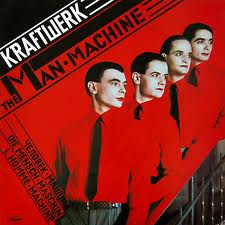
In truth, the only brush with absolute modernity in music that I'd experienced came in 1974 when I'd been briefly obsessed with Kraftwerk. "Autobahn" sounded unlike anything that I'd ever heard, was absolutely 'new' and 'now'. They were truly 'Mod', if anything was. The recent MOMA retrospective featuring the band's music remind me of exactly how 'Mod' they were back then. In 1981 they managed to spark the hip-hop movement with "Man Machine" (check out "Planet Rock" for proof) and that recording is still being heard on contemporary pop hits — Nicki Minaj's Starship samples it, for instance.


I admit that interest in Kratfwerk lead me to a disastrous dalliance with Tangerine Dream—who were far too hippyish for me—but it also led me to Stockhausen, Ligetti and Steve Reich, for which I will ever be grateful to the Dusseldorfers. Interst in the Jam led me to the Kinks. Today, neither Weller nor Kraftwrk can remotely be considered as 'Mod' in the original sense of the term; it was of course an abbreviation of 'Modern'.


But then, what is 'Mod', these days?


Monday, 23 April 2012

Old Mod and Skinhead Go Shopping (Tighten Up)


Derek, was a Mod in the 1960s who became a Skinhead in the same decade. He shopped at a lot of the same places, wore the same kind of gear and rode the same kind of scooter. The music changed along with the hair and class attitude, but the Mods had been around for too long by 1968. They'd appeared at a time when a Tory government told the people that they'd never had it so good, and really got going before Christine Keeler and Mandy Rice-Davies did for the Conservatives in 1962.


"I became a Skin partly because the nob-end of the hippy scene started taking over our look, and partly because I really didn't like the hippies. Being a Skin meant not having to buy new suits all the time, just shirts, trousers, shoes and braces. Suits were for the middle-class, I were from the working class and proud of it. Mind you, I didn't like Labour neither. They were too soft on the hippies and commies."


"By the end of the 1960s I couldn't be bothered too much with shopping. I knew what I wanted, where to get it and how much it cost. So I'd always go to the places I knew best. And after I got married, me misses bought stuff for me and being a Skin started to come second to everything else. Know what I mean?"