Wednesday, 4 April 2012

Too Much Skinhead Fighting On The Dancefloor (Burn It Down)


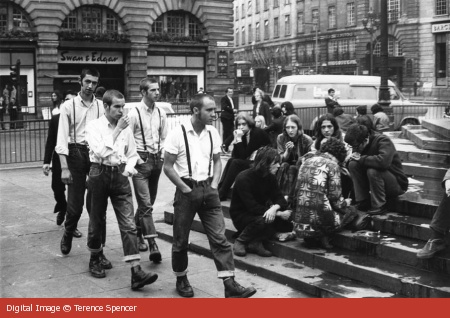
Krish was a skinhead. He had a number 1 crop, a checked, button down Ben Sherman, red braces, skinny 501's, 8-hole Doc Martens and a red Harrington. He used to 'do' security at a squat bar in West Hampstead, circa 1982, and always carried a sawn-off snooker cue wrapped in gaffer tape ("so it don't splinter when I 'it people wiv it") while on duty. Some Saturday nights Krish would bring his best mate Alf along to help out. Alf wore a tonic suit, white shirt, skinny black wool tie and monkey boots. Sometimes she'd wear a trilby hat, but after it got stamped flat at a Meteors gig where she and Krish were supposed to be minding our PA stack, she'd taken to only wearing it when off duty.


Krish was from a wealthy Cypriot family who were desperate to get him back home from the squat he shared with Alf and three women who wanted to set up an anarchist brothel, in Brixton. Can't think why, but Krish's parents kept trying to get him certified insane, so he told us. They'd offered him money, a holiday, a new car, anything if he'd give up Alf and return home and settle down to a life as an accountant. At least, that was how he explained the wads of cash he'd sometimes turn up with and hand out as if £10 notes were Bensons.


Krish loved it at the squat bar in NW6. The music we played was a mixture of proper old soul, pure punk, post-punk, funk and reggae, all of which he said he loved, and would spend most of the night dancing to as he swigged Tennents Super, speeding off his head on blues (which we'd trade, 2 for a beer). Most nights, in order to get it together Krish would toke on a joint as it made its way round the 'staff', usually some time after 2am.


When the pubs closed the bar—which was once a Turkish restaurant—would fill up with the local and not so local punks, musicians, jokers and tokers (though hippies were thoroughly discouraged) from Kilburn, Camden, Willesden and all points North and West. If the booze ran out (always sold at cost or swapped for similar substances) before everyone left, it would be topped up with a trip to Willesden Lane and the all-night corner store opposite the aptly named Bliss chemist.


Local dealers kept everything else topped up. It was a cool place throughout the winter of '82 and into late summer '83, open very Friday and Saturday night, entrance free. Sometimes a band would play, more often cassettes made up for the night would play through a small band PA.


Then Geronimo and the spider web gang found out about the place and turned up one sunny Summer evening. It was early, about 9, so no-one was in except Krish, Alf, Speedy Steve, Mick the mechanic and a couple of us squatters. The skinhead gang all had spider webs tattooed on their faces, necks or heads, all of which were done using  biro, in borstal. You had to get a spider web tattoo if you wanted to be in the gang. Geronimo their leader also had 'cut here' and a dotted line around his neck, 'hate' tattooed on the chuckles of both hands and a little bird on his left cheek. His head and right cheek was covered in the web.


The spiders all lived in grotty ex-council flat squats on the Abbey Road estate and either mugged or 'begged' money on Mill Lane in West Hampstead and the passageway that ran from beside the Moonlight Club to Finchley Road. Most of them were scrawny kids and usually too out of it on glue or Tennents Super to be any real trouble. Geronimo was a different matter, though. Just out of Borstal, bristling with anger and psychotically deranged by glue, he banged through the plate glass door of the bar and dropped straight into a press-up stance. Shouting 'one-two' he pressed using one arm for twenty and then switched to the other arm. His gang stood outside, watching through the windows, open-mouthed and tetchy in Crombie coats, Harringtons and the odd MA1 jacket: it was still hot outside.


After finishing his press ups, Geronimo shot upright, flexed his muscles and turned to the door, which had swung shut behind him. As if affronted by the door having acted against his wishes, he stepped up to it and head butted the plate glass. Which shattered. Then he picked up a chair and threw it at the window, which didn't break. That was the signal for the gang to spring into life. They ran in and started to rearrange the furniture, such as it was. Krish, who looked just like them minus the spider web, shifted himself quietly among them as they raged among our skip-found chairs and crooked tables. Positioning himself behind Geronimo, Krish heaved back with the snooker cue and whacked the spider web on the side of the big skin's face, following it up with a swift kick between Geronimo's legs.


Everything stopped, chairs were held in mid-air, everyone gaped at the big skin as he stood, shoulders hunched, unmoving for a second that stretched into what seemed like a minute.
"Hunh."
Geronimo turned slowly to face Krish who backed off two steps with his cue raised at shoulder height.
"Shit."
"Hrrrrhnnnn!" Geronimo lurched at Krish who ducked and ran out the door, sending a kick at the nearest spider web before scuttling under the nearest stationery vehicle, and old, rusting ambulance. Geronimo and his gang tried the kick Krish out from under the van, but ended up smashing the windows, headlamps and mirrors in frustration as he stated put. After  a few minutes, with our windows smashed, the furniture ready for the fire and the old van standing firm, Geronimo led his faithful clan off up the Finchley Road in search of more mayhem.


Krish and Alf drifted away soon after that, and we also moved on, squatting an old cinema up the road where we put on gigs, events and blues nights (sound systems only). At Christmas 1983 we heard that Krish's parents had hired a couple of guys to kidnap their son, and he was sectioned, sitting in a south London psychiatric ward, nodding out as his hair grew. Alf had a plan to get him out though, which meant she had to dress like a girl (he was willing just that once) but which worked, and briefly in mid-1984 the pair of them returned to the scene, looking smart and dancing as only they could, helping us with pro-Miner's gigs, benefits and protests. They were married, Alf said, so his parents couldn't section him without her say-so.


Krish committed suicide in 1985.


Monday, 26 March 2012

Suedehead Looks Back


Cal, 54, is a squat, square, bald-headed pit bull of a man. Standing about 5' 7" in his AirWare soles, his M1 flying jacket looks as if it has just been washed, his too-tight stone-washed jeans have a central crease, the dark blue Fred Perry is almost new. Diamonds of light sparkle on his ox-blood DMs, occasionally the fat sovereign ring on his left hand dully threatens to rip the side pocket on his jacket.
"You mightn't reckon it now, but once a time I was a scary suede head," his smile leans forward like a shark having a sniff at an unexpected foodstuff.


"Back in the early '70s I was a Shed Ender, spent Saturdays either ripping into train seats or dickheads who weren't Chelsea. That was when I could afford to get to London, 'course. If I couldn't bunk a train I'd get my hair trimmed of adorning, have a couple of pints and then see me bird 'til it was time to go out and start a ruck in a pub or disco."
These days Cal spends Saturdays minding the counter at the newsagents he runs, nipping across to the bookies with a bet or two and waiting for closing time so he can have a couple of pints before heading home to get ready.


"There's usually a '70s disco or Northern Soul night on somewhere round here, so me and missus number 3 like to get done up, have a few and shake it about on the dance floor. It's funny though," Cal doesn't look amused, "I never used to dance much back then. I was always too pissed or busy trying to start a fight in the bogs".


Back in 1972 Cal was a trainee Headhunter, one of a handful of 4th formers who'd earn their place in the hooligan hierarchy by leading what looked like suicidal attacks on rival football teams supporters. "We'd have to get stuck in on our own for a good 5-10 minutes while the big boys watched from round a corner or something," Cal's fat neck creases with the effort of shaking his head, "and if we stood our ground—against proper hooligans sometimes, like the Inter City Firm—then we'd get bought beer all night by the bosses. Sometimes though we had to run, and get the dopes to follow us into a trap, the Headhunters would jump them as they came round a corner, swinging chains, slicing with Stanley knives and all that." The top of Cal's left ear and right cheek just below his eye still carry scars where he didn't get away in time. Not that he ever ran away unless told to by a Headhunter.


Cal's fledgling hooligan career was begun as a skinhead in 1970, but two years later he wore the longer crop and sideburns of a suede head. "I also had an 'orrible little moustache like Hitler when I was 15," his grimace is a frightening sight. "But that was mainly to show my old man that I was as big and tough as he was". Cal's old man was a builder's foreman, bald since the age of 21 he was a former Teddy Boy who used his fists to instil discipline in his kids and building site crew alike. "He was a tough bastard," Cal recalls (not at all fondly).


"I did a couple of summers working with him on a site in the West Country, building a prison, I think it was. We slept in a caravan and drank scrumpy after work every night, ate fish and chip suppers, smoked roll ups. He spent his life working away from home all week, coming back to our house at the weekend. I hardly knew him." Cal didn't know his old man well enough to not call him out one Saturday night in mid-winter.


There was a power cut on and his old man had rigged up a gas-powered arc lamp he 'borrowed' from work in the yard outside the kitchen window. "It was bloody bright, made every shadow in the place huge." Dinner was, as usual, a silent affair. "My old man ruled the place and told us when to talk. I was fifteen and had been running with the Headhunters for a while so I thought, 'I'm not having this', and I started talking some bollocks to my little brother. The old man said 'shut it'. I said, 'No, you shut it'. Well, he turned red. 'Think you're hard enough son?' he asked. 'Outside then'. The old lady started crying and I almost shat myself but thought, 'gotta do it, he's an old man…'."


The fight was short. "He hit me once and that arc light went out. I never stood a chance." It was the beginning of the end of Cal's hooligan phase. "I thought, if I can't beat him, I'm going to lose it to some tosser sooner or later, maybe I'll give something else a look." Plus, it saved him some money. "Yeah, well,  I went to live with my old gran the week after that. I couldn't face him even at weekends. Plus, I had a bird I was serious about at the time—Angie, just like in that song—and she was allowed stay over at Grans. So we'd spend Saturdays shopping, dancing, seeing some gigs and that. I remember going to see Ronnie Lane's Slim Chance in a field the summer after, and he was growing out the suede head look, which I kinda started doing. Mind you, I didn't go in for that hippy look. Had to stay smart, eh?"


Cal's old man died at 46 of a heart attack. "Dropped dead at work apparently, in the middle of bollocking someone. Stupid bastard." Cal's laugh sounded like a dog hiccupping. "I didn't hate him, though. He did what he thought he had to do, and he probably saved me from a few extra scars." He shrugs, or twitches his shoulders at least.


"Now, any time I want to remember him and what he was, I just go and look in the mirror. A few years back I thought I saw him in shop window,  gave me a right shock. 'It's him, my old man!' I thought, and turned round to say something. 'Course he wasn't there. It was my own bloody reflection. What a twat, eh?" That hiccupping dog returns for a long minute. Then Cal slowly shakes his head, wipes what might be a tear from the scar under his eye and waddles off to look for missus number 3. There's a Faces tribute band playing tonight in a pub up the road. Of course they're going.

Monday, 19 March 2012

Old Mod Looking Back (Can't Explain)


June 1979, I'm aged 17 and recently left home to live on the top floor of a pub. It's a big room, running front-to-back of the building, with a window at the front looking out over a marketplace, and the cop shop at the back. I'm a regular of three years drinking at the Lion's Head, get on well with Mike the landlord and serve at the bar one night a week to pay the rent (£40 a month). We enjoy the same music, which is one reason we get on. Saturday afternoon and I'm sitting on a stool at the bar, waiting for a man.
"How'd you fancy seeing The Who at Wembley?" asks Mike with his back to me, getting a shot of rum from the optics.
"I dunno, now Keith Moon's dead do I want to see The Who perform without him?"
"Well if you do, I've got a couple of tickets and 'Chelle doesn't want to go". ('Chelle's his wife, a willowy brunette who looks like a Pans People dancer)
"How much is the ticket?"
"S'alright, it's on me. You can drive though."
I think for as long as it takes for a sip of mild to go down.
"You're on".


It's not often that you get to walk out onto the pitch at Wembley Stadium. Pity it's covered in tarpaulin, hippies and the New Mods wearing fishtail parkas, target badges and cheap pork pie hats, but till, I can pretend for a moment that I'm there for a game. I'm wearing Levi's, Doc Marten boots (eight-hole), a Ben Sherman button-down and black Harrington. Mike, in his dark blue Harrington, white Sta-prest and brogues doesn't want to sully the cloth by mixing with the masses; also, he wants to sit.


I spot a couple of friends down among the throng early on, and work my way through the patchouli, cider and dope smoke to get to them as Nils Lofgren starts bouncing on his trampoline. When AC/DC ramble on I head back to the seats, and then the bar until they've gone. When the Stranglers walk out I seriously consider going down front in order to pitch a Party 4 can at them. Sexist wankers still riding the long-dead punk bandwagon, hope the smack gets them all.


It's getting dark by the time that Townshend walks out ahead of his bandmates. Glad that they've not worn any Mod gear, even though they are here to promote the new Quadrophenia movie. "Substitute" makes the hairs on the back of my neck stand up, and I'm happy as Jack that the sound's good, the lasers not too over the top and Kenney Jones can keep the beat, even if he's not going to demolish anything on stage. After "Can't Explain" and "Baba O'Reilly" crash to a close, the stadium is rocking. I'm standing and swaying, as even the usually too-cool-to-bop Mike is tapping his toes. When they launch into "My Generation" though, I suddenly feel embarrassed, and kind of sad.


As the darkening night air fills with the sound of 80,000 people joining in the death chant, I stand still and sink. It's all over. I'm 17 and will never be able to say that I saw the Who in 1968 with Moon, never saw the Stones in 1972, never saw The Doors play live. Punk was everything to me and my generation, and here I stand among thousands of kids getting into a dead scene, all nostalgic for 1964 and a time before many of them had been born. Looking back, and without knowing such things existed, I was aware that I was watching The Who Are You?: A Tribute Band, featuring most of the original members.


The final encore number was The Real Me. Was it? I asked myself.
The drive back in Mike's canary yellow Cortina 2.0 GXL was ringing with silence, our ears still echoing Townshend's windmilling guitar.
"That was alright, wasn't it?" Mike half-shouted.
"Yeah. Alright."
"Not sure I'd see them again though."
"No. Me neither".


Searching through the glove compartment for an 8-track that might fill the deep well of bass sounding in my inner ear, I fish out Marvin Gaye's What's Goin' On. The car is soon filled with rattling bongoes, swooping voices, soaring strings, horns and Marvin asking, "Hey baby, what you know? Good." I'm just getting back, like you knew I would.

Tuesday, 13 March 2012

Old Mods & Skinheads Looking Back (A Message To You, Rudy)


Danny, 64, pulls his checked button-down collar away from his neck and frowns.
"So what I want to know is, where did the bloody skinheads come from?"
Jimmy, 55, shifts his weight onto his left foot and smiles.
"Places you didn't like to visit, mate."
"I know there was a Mod link," Danny continues frowning, "But in 1968, I was a Mod and just after I'd bought my first proper suit from a tailor, I was chased down the World's End by a pair of skinheads who caught me, slashed my jacket and left this as a reminder of our meeting…" he pulls the collar further away from his neck, turns his head and shows off a 43-year old scar running from behind his ear and up into his white-grey hairline. "The suit was lovely too, in two-tone silver and blue, with two side vents, tapered trousers, four buttons and a dark plum lining."
"Oooph. Must have hurt."
"Yeah, the ripped suit as much as the cut head. I never got why they did it. Why did they fight the Mods and the Hippies?"


"My bother was a skinhead," Jimmy offers, "and he was a psycho, basically. Aged 14 he got dragged home one Saturday evening by two coppers after trashing a train on his way back from a Chelsea game. That must have been around 1969. He was four years older than me, and a right bully. He used to be the school boxing champion—not because he was any good, but because he wouldn't give up, just kept swinging and didn't obey any rules, so no-one wanted to fight him. He used to 'spar' with me and vey kindly used to let me wear the gloves. One of these lumps"–he points to his bent nose— "is a product of those sparring sessions."


Scars compared, the old Mod and Skinhead get to discussing clothes.
"I liked the sharp trousers, properly buttoned shirt and Crombie coat," Danny says. "And the brogues, of course.
"Now there's part of the reason that Skins hated the Mods," Jimmy suggests. "Mods were middle-class, had jobs, money and an education. Proper brogues were expensive which is why work boots, properly shine up were worn along with the turned up jeans and Crombie, or sheepskin coat if you could afford one."
"Yeah, I knew I couldn't be a proper Skin because I was middle class," Danny sighs heavily. "I came from Finchley, and trained to be an accountant."
"That's where you went wrong, see? Skinheads were working class and pissed off about the changing state of the nation back then. Hippies were mostly middle-class layabouts as far as the skins were concerned, and they had no self-respect. The tonic suits, hats and music Skins were into came out of Jamaica, where the cool rudies of West London, Handsworth and Toxteth came from originally. They went to the same schools as the skins and their music, dances and attitude—weirdly influenced by Westerns, I might add—was too attractive to ignore for the Skins who had no 'culture' that they could relate to from their parents or big brothers. I mean, who wants to hear a 20-minute drum solo while stoned out of your mind?"


"The original skinheads weren't racists, were they?"
"Nah, they were class warriors, mate. Or at least they could have been if the idiot element among 'em hadn't loved the way a shaved head and big boots scared people, and got off on the violence."
"And then it became fashionable, of course, which is the end of everything, right?"
"Right. I blame those stupid books by Richard Allen. After the first one was a big seller everyone started moon stomping on to the bandwagon. Remember Slade? A piss-poor metal band from Wolverhampton, they cut all their hair off in 1969 and became skinheads. Didn't work though, so they grew it again, put glitter on their mugs and became pop stars. It was never gonna work for them though, 'cos Reggae was the only music skins would dance to."


"Those Tighten Up albums were great, weren't they? And not just because of the sleeves."
"See, Mods were still into American soul or English rock n roll like The Who or Small Faces at the time, and the original reggae singles were all rare and either only heard at Jamaican blues parties or on pirate radio stations. You had to go out looking for the music, the scene, back then. None of this browsing Facebook for 'mates' based on their 'likes'.Original skins were very community-minded really, there was a lot of support given by the boys and girls to those who chose to wear the gear, cut their hair and be shunned by the rest of society."


"I was a skinhead, briefly. Aged nine or ten, I got my head shaved just like my brother, got handed down his old Harrington jacket and a pair of DM boots, and loved the feel of the outfit. Me and a couple of mates had a great time swaggering around the alleys where we'd play football with our scarves hanging off our s-belts. Mind you, we were always being given grief by teachers for the way we looked. And then David Bowie appeared and it wasn't long before I was being sent home from school for having a Bowie haircut…"


"Later, after Punk had become fashionable (in early 1978) and I gave up on it, I briefly went back to the Skin look. But by then those horrible NF gits had given the look a very bad name, and after a couple of rucks with Cockney Reject fans I went completely the other way."
"Morrissey had a thing for skinheads, too…"
"Naturally. It was an attractive look for people of his—our—age. There's a, waddyacallit … homoerotic appeal to that brutal, shaved look, right? The threat of violence, all that masculine power dressed up in those cute clothes. If you fancy a bit of stylish rough, what's not to like?"


Tuesday, 6 March 2012

Seven Days Is Too Long


Last weekend the BBC in the UK broadcast a documentary about Disco, and it was every bit as predictable, safe, cursory and piecemeal as any hour-long documentary about a significant subject can be. Exactly who the programme makers thought their audience were is unclear to me. I accept that I wasn't on their list of desirable consumers (and if I was I'd be mortified), but plenty of people I know who would be interested in watching a good, in-depth exploration of the Disco phenomenon on TV can only have been left shrugging their shoulders with a "Meh"after watching this.


My mid-teenage daughters were not particularly interested in the documentary, either. The youngest enjoyed matching pages from my book with the 2-minute segments in the programme which made good use of similar material, but she was soon lost in the pages of the book and ignored the talking heads. Why Alexis Petridis? Too young to have been there at the time, he's not to know that Boney M were never played at any disco where you had to be over 18 to gain admittance. His, like the programme makers, view of disco is based purely on what can be found out about it from the archives of mainstream media, none of which were interested in the real throbbing heart of disco at the time. The defining and essential disco discourse exists outside of the mainstream, and although people now accept that many discos were gathering places for oppressed minorities, still they focus on pop charts as background for what was a cult movement. That is like reading tabloid newspapers for in-depth news analysis.


White, male music journalists working at mainstream publications ignored Disco in the 1970s and well into the 1980s. But then they generally ignored all black music except some Jazz played by white people who were Prog Rockers in disguise. Soul, R&B and Reggae—when Johnny Rotten said it was OK—might have gained some review coverage, but only Bob Marley ever got the front page of music magazines until the 1980s. As late as 1991 Ice T was denied the cover of a mainstream UK monthly music magazine because, as the publisher put it, 'black artists on the cover caused a drop in sales'.


When the white, hetero mainstream music press started bigging up 'gangsta rap' (silly boys with mother complexes and impotency problems I always thought; both rappers and the boys who wrote about it) in the 1990s, it was the first time that an overtly black urban music found any kind of space in that kind of media. During the heyday of disco the only 'club scene' to be written about, if only cursorily, by mainstream music press (including the NME; a wholly owned part of an enormous magazine corporation called IPC) was Northern Soul. Bizarrely it was featured in the disco documentary which found no time to go into HI-NRG.


The Northern Soul scene grew up in a few tatty dance halls in the increasingly depressed and depressing Northern industrial towns of England, in the 1970s. Every Saturday night, predominantly white males who were ex-Mods, skinheads and their younger brothers, insisted on showing off fancy footwork, physical prowess and shoes like dead pigs noses while throwing identical moves to any obscure Motown, Argo, Stateside, Mojo and Stax single that they could get hold of. It was a small scene and essentially conservative, which is why it persists to this day. Northern Soul nights still look, smell and sound exactly as they did in the 1970s, and that's the way they have to stay: Northern Soul is strictly, staunchly nostalgic—for people too young these days for the nostalgia to be anything but imagined and desired. Today's dancers were not at Wigan Casino in 1974 but the places and the sounds have stayed the same, so for one night they can pretend to to be.


Which is kinda the way it always was. Northern Soul dancers of the '70s liked to imagine that they were at some Southern State dancehall, with chicken grease solidifying on paper baskets in 1966, before Otis took his last plane ride. The music played at a Northern Soul clubs back then, as now, had to be obscure (i.e. never a hit on the charts), have the standard Motown/Stax/Funky Drummer snare beat and be available only on 7" vinyl. Oh, and it was always the b-side that got played. There was no way that Northern Soul dancers could possibly show off for as long as a 12" single would take to spin out.


The thing is, that scene was avidly, determinedly and vehemently anti-disco. No records pressed later than 1971 could be danced to by Northern Soulers (until the end of the '70s, anyway), and certainly nothing with that smooth, sexy Philly Sound. The Northern Soul dance floor was not for meeting, greeting, picking up and loving, like discos were. It was a purely gladiatorial arena. Northern Soul dancers competed in unspoken contest with one another, pirouetting, dropping, knee-bending, high-kicking and doing the splits harder, faster and for longer than any other guy on the floor was the main aim of a 'proper' Northern Soul dancer. There were no 'couples' dancing at Northern Soul clubs.


Northern Soul dancers were proud to not be disco dancers, to not be reminded of the date, time and place in which they had to exist (Doncaster could be Chicago if you squinted hard enough in the rain…). When fashions changed and people everywhere stopped wearing high-waisted, 40" flares and cap-sleeve t-shirts, Northern Soulers had to start buying them at charity stores.They would only visit a straight disco club if there was a Sixties Soul Night or similar, specially themed evening on and no records of the day were being played. Not that this point was made in the documentary, of course. But hey, the film makers are young, and they got an interview with a 'legendary' DJ who liked the Northern Soul scene. Plus, there's been a recent resurgence in popularity for the Northern Soul sound in England, with clubs across the land filling up with people desperate to 'keep the faith'. They even replicate old designs on posters in order to capture that long-lost 1960s soul feeling.


The story of Disco according to the BBC, starts with Stonewall and ends with the Disco Sucks demolition night. According to the BBC it is a Gay Pride off-shoot, purely American and became very silly when Ethel Merman made a disco album. Also, Bony M are as important to the movement as Donna Summer and The Bee Gees. At least Tom Moulton made a very brief appearance, although he didn't get to tell us how he invented the 12" single, which is a shame.


Thankfully there are plenty of sites which promote the real story of disco for anyone interested enough to want to know. Like life though, Disco is complicated, and not easily packaged into bite-size chunks. It's best enjoyed loudly and with plenty of room to dance.