Monday, 19 March 2012
Old Mod Looking Back (Can't Explain)
June 1979, I'm aged 17 and recently left home to live on the top floor of a pub. It's a big room, running front-to-back of the building, with a window at the front looking out over a marketplace, and the cop shop at the back. I'm a regular of three years drinking at the Lion's Head, get on well with Mike the landlord and serve at the bar one night a week to pay the rent (£40 a month). We enjoy the same music, which is one reason we get on. Saturday afternoon and I'm sitting on a stool at the bar, waiting for a man.
"How'd you fancy seeing The Who at Wembley?" asks Mike with his back to me, getting a shot of rum from the optics.
"I dunno, now Keith Moon's dead do I want to see The Who perform without him?"
"Well if you do, I've got a couple of tickets and 'Chelle doesn't want to go". ('Chelle's his wife, a willowy brunette who looks like a Pans People dancer)
"How much is the ticket?"
"S'alright, it's on me. You can drive though."
I think for as long as it takes for a sip of mild to go down.
"You're on".
It's not often that you get to walk out onto the pitch at Wembley Stadium. Pity it's covered in tarpaulin, hippies and the New Mods wearing fishtail parkas, target badges and cheap pork pie hats, but till, I can pretend for a moment that I'm there for a game. I'm wearing Levi's, Doc Marten boots (eight-hole), a Ben Sherman button-down and black Harrington. Mike, in his dark blue Harrington, white Sta-prest and brogues doesn't want to sully the cloth by mixing with the masses; also, he wants to sit.
I spot a couple of friends down among the throng early on, and work my way through the patchouli, cider and dope smoke to get to them as Nils Lofgren starts bouncing on his trampoline. When AC/DC ramble on I head back to the seats, and then the bar until they've gone. When the Stranglers walk out I seriously consider going down front in order to pitch a Party 4 can at them. Sexist wankers still riding the long-dead punk bandwagon, hope the smack gets them all.
It's getting dark by the time that Townshend walks out ahead of his bandmates. Glad that they've not worn any Mod gear, even though they are here to promote the new Quadrophenia movie. "Substitute" makes the hairs on the back of my neck stand up, and I'm happy as Jack that the sound's good, the lasers not too over the top and Kenney Jones can keep the beat, even if he's not going to demolish anything on stage. After "Can't Explain" and "Baba O'Reilly" crash to a close, the stadium is rocking. I'm standing and swaying, as even the usually too-cool-to-bop Mike is tapping his toes. When they launch into "My Generation" though, I suddenly feel embarrassed, and kind of sad.
As the darkening night air fills with the sound of 80,000 people joining in the death chant, I stand still and sink. It's all over. I'm 17 and will never be able to say that I saw the Who in 1968 with Moon, never saw the Stones in 1972, never saw The Doors play live. Punk was everything to me and my generation, and here I stand among thousands of kids getting into a dead scene, all nostalgic for 1964 and a time before many of them had been born. Looking back, and without knowing such things existed, I was aware that I was watching The Who Are You?: A Tribute Band, featuring most of the original members.
The final encore number was The Real Me. Was it? I asked myself.
The drive back in Mike's canary yellow Cortina 2.0 GXL was ringing with silence, our ears still echoing Townshend's windmilling guitar.
"That was alright, wasn't it?" Mike half-shouted.
"Yeah. Alright."
"Not sure I'd see them again though."
"No. Me neither".
Searching through the glove compartment for an 8-track that might fill the deep well of bass sounding in my inner ear, I fish out Marvin Gaye's What's Goin' On. The car is soon filled with rattling bongoes, swooping voices, soaring strings, horns and Marvin asking, "Hey baby, what you know? Good." I'm just getting back, like you knew I would.
Tuesday, 13 March 2012
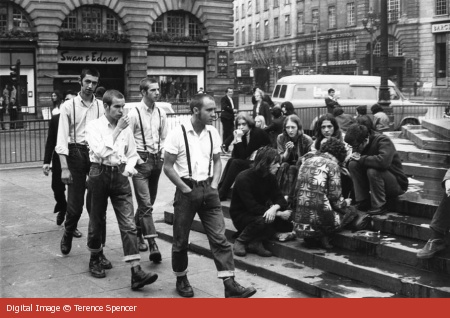
Old Mods & Skinheads Looking Back (A Message To You, Rudy)
Danny, 64, pulls his checked button-down collar away from his neck and frowns.
"So what I want to know is, where did the bloody skinheads come from?"
Jimmy, 55, shifts his weight onto his left foot and smiles.
"Places you didn't like to visit, mate."
"I know there was a Mod link," Danny continues frowning, "But in 1968, I was a Mod and just after I'd bought my first proper suit from a tailor, I was chased down the World's End by a pair of skinheads who caught me, slashed my jacket and left this as a reminder of our meeting…" he pulls the collar further away from his neck, turns his head and shows off a 43-year old scar running from behind his ear and up into his white-grey hairline. "The suit was lovely too, in two-tone silver and blue, with two side vents, tapered trousers, four buttons and a dark plum lining."
"Oooph. Must have hurt."
"Yeah, the ripped suit as much as the cut head. I never got why they did it. Why did they fight the Mods and the Hippies?"
"My bother was a skinhead," Jimmy offers, "and he was a psycho, basically. Aged 14 he got dragged home one Saturday evening by two coppers after trashing a train on his way back from a Chelsea game. That must have been around 1969. He was four years older than me, and a right bully. He used to be the school boxing champion—not because he was any good, but because he wouldn't give up, just kept swinging and didn't obey any rules, so no-one wanted to fight him. He used to 'spar' with me and vey kindly used to let me wear the gloves. One of these lumps"–he points to his bent nose— "is a product of those sparring sessions."
Scars compared, the old Mod and Skinhead get to discussing clothes.
"I liked the sharp trousers, properly buttoned shirt and Crombie coat," Danny says. "And the brogues, of course.
"Now there's part of the reason that Skins hated the Mods," Jimmy suggests. "Mods were middle-class, had jobs, money and an education. Proper brogues were expensive which is why work boots, properly shine up were worn along with the turned up jeans and Crombie, or sheepskin coat if you could afford one."
"Yeah, I knew I couldn't be a proper Skin because I was middle class," Danny sighs heavily. "I came from Finchley, and trained to be an accountant."
"That's where you went wrong, see? Skinheads were working class and pissed off about the changing state of the nation back then. Hippies were mostly middle-class layabouts as far as the skins were concerned, and they had no self-respect. The tonic suits, hats and music Skins were into came out of Jamaica, where the cool rudies of West London, Handsworth and Toxteth came from originally. They went to the same schools as the skins and their music, dances and attitude—weirdly influenced by Westerns, I might add—was too attractive to ignore for the Skins who had no 'culture' that they could relate to from their parents or big brothers. I mean, who wants to hear a 20-minute drum solo while stoned out of your mind?"
"The original skinheads weren't racists, were they?"
"Nah, they were class warriors, mate. Or at least they could have been if the idiot element among 'em hadn't loved the way a shaved head and big boots scared people, and got off on the violence."
"And then it became fashionable, of course, which is the end of everything, right?"
"Right. I blame those stupid books by Richard Allen. After the first one was a big seller everyone started moon stomping on to the bandwagon. Remember Slade? A piss-poor metal band from Wolverhampton, they cut all their hair off in 1969 and became skinheads. Didn't work though, so they grew it again, put glitter on their mugs and became pop stars. It was never gonna work for them though, 'cos Reggae was the only music skins would dance to."
"Those Tighten Up albums were great, weren't they? And not just because of the sleeves."
"See, Mods were still into American soul or English rock n roll like The Who or Small Faces at the time, and the original reggae singles were all rare and either only heard at Jamaican blues parties or on pirate radio stations. You had to go out looking for the music, the scene, back then. None of this browsing Facebook for 'mates' based on their 'likes'.Original skins were very community-minded really, there was a lot of support given by the boys and girls to those who chose to wear the gear, cut their hair and be shunned by the rest of society."
"I was a skinhead, briefly. Aged nine or ten, I got my head shaved just like my brother, got handed down his old Harrington jacket and a pair of DM boots, and loved the feel of the outfit. Me and a couple of mates had a great time swaggering around the alleys where we'd play football with our scarves hanging off our s-belts. Mind you, we were always being given grief by teachers for the way we looked. And then David Bowie appeared and it wasn't long before I was being sent home from school for having a Bowie haircut…"
"Later, after Punk had become fashionable (in early 1978) and I gave up on it, I briefly went back to the Skin look. But by then those horrible NF gits had given the look a very bad name, and after a couple of rucks with Cockney Reject fans I went completely the other way."
"Morrissey had a thing for skinheads, too…"
"Naturally. It was an attractive look for people of his—our—age. There's a, waddyacallit … homoerotic appeal to that brutal, shaved look, right? The threat of violence, all that masculine power dressed up in those cute clothes. If you fancy a bit of stylish rough, what's not to like?"
Tuesday, 6 March 2012
Seven Days Is Too Long
Last weekend the BBC in the UK broadcast a documentary about Disco, and it was every bit as predictable, safe, cursory and piecemeal as any hour-long documentary about a significant subject can be. Exactly who the programme makers thought their audience were is unclear to me. I accept that I wasn't on their list of desirable consumers (and if I was I'd be mortified), but plenty of people I know who would be interested in watching a good, in-depth exploration of the Disco phenomenon on TV can only have been left shrugging their shoulders with a "Meh"after watching this.
My mid-teenage daughters were not particularly interested in the documentary, either. The youngest enjoyed matching pages from my book with the 2-minute segments in the programme which made good use of similar material, but she was soon lost in the pages of the book and ignored the talking heads. Why Alexis Petridis? Too young to have been there at the time, he's not to know that Boney M were never played at any disco where you had to be over 18 to gain admittance. His, like the programme makers, view of disco is based purely on what can be found out about it from the archives of mainstream media, none of which were interested in the real throbbing heart of disco at the time. The defining and essential disco discourse exists outside of the mainstream, and although people now accept that many discos were gathering places for oppressed minorities, still they focus on pop charts as background for what was a cult movement. That is like reading tabloid newspapers for in-depth news analysis.
White, male music journalists working at mainstream publications ignored Disco in the 1970s and well into the 1980s. But then they generally ignored all black music except some Jazz played by white people who were Prog Rockers in disguise. Soul, R&B and Reggae—when Johnny Rotten said it was OK—might have gained some review coverage, but only Bob Marley ever got the front page of music magazines until the 1980s. As late as 1991 Ice T was denied the cover of a mainstream UK monthly music magazine because, as the publisher put it, 'black artists on the cover caused a drop in sales'.
When the white, hetero mainstream music press started bigging up 'gangsta rap' (silly boys with mother complexes and impotency problems I always thought; both rappers and the boys who wrote about it) in the 1990s, it was the first time that an overtly black urban music found any kind of space in that kind of media. During the heyday of disco the only 'club scene' to be written about, if only cursorily, by mainstream music press (including the NME; a wholly owned part of an enormous magazine corporation called IPC) was Northern Soul. Bizarrely it was featured in the disco documentary which found no time to go into HI-NRG.
The Northern Soul scene grew up in a few tatty dance halls in the increasingly depressed and depressing Northern industrial towns of England, in the 1970s. Every Saturday night, predominantly white males who were ex-Mods, skinheads and their younger brothers, insisted on showing off fancy footwork, physical prowess and shoes like dead pigs noses while throwing identical moves to any obscure Motown, Argo, Stateside, Mojo and Stax single that they could get hold of. It was a small scene and essentially conservative, which is why it persists to this day. Northern Soul nights still look, smell and sound exactly as they did in the 1970s, and that's the way they have to stay: Northern Soul is strictly, staunchly nostalgic—for people too young these days for the nostalgia to be anything but imagined and desired. Today's dancers were not at Wigan Casino in 1974 but the places and the sounds have stayed the same, so for one night they can pretend to to be.
Which is kinda the way it always was. Northern Soul dancers of the '70s liked to imagine that they were at some Southern State dancehall, with chicken grease solidifying on paper baskets in 1966, before Otis took his last plane ride. The music played at a Northern Soul clubs back then, as now, had to be obscure (i.e. never a hit on the charts), have the standard Motown/Stax/Funky Drummer snare beat and be available only on 7" vinyl. Oh, and it was always the b-side that got played. There was no way that Northern Soul dancers could possibly show off for as long as a 12" single would take to spin out.
The thing is, that scene was avidly, determinedly and vehemently anti-disco. No records pressed later than 1971 could be danced to by Northern Soulers (until the end of the '70s, anyway), and certainly nothing with that smooth, sexy Philly Sound. The Northern Soul dance floor was not for meeting, greeting, picking up and loving, like discos were. It was a purely gladiatorial arena. Northern Soul dancers competed in unspoken contest with one another, pirouetting, dropping, knee-bending, high-kicking and doing the splits harder, faster and for longer than any other guy on the floor was the main aim of a 'proper' Northern Soul dancer. There were no 'couples' dancing at Northern Soul clubs.
Northern Soul dancers were proud to not be disco dancers, to not be reminded of the date, time and place in which they had to exist (Doncaster could be Chicago if you squinted hard enough in the rain…). When fashions changed and people everywhere stopped wearing high-waisted, 40" flares and cap-sleeve t-shirts, Northern Soulers had to start buying them at charity stores.They would only visit a straight disco club if there was a Sixties Soul Night or similar, specially themed evening on and no records of the day were being played. Not that this point was made in the documentary, of course. But hey, the film makers are young, and they got an interview with a 'legendary' DJ who liked the Northern Soul scene. Plus, there's been a recent resurgence in popularity for the Northern Soul sound in England, with clubs across the land filling up with people desperate to 'keep the faith'. They even replicate old designs on posters in order to capture that long-lost 1960s soul feeling.
The story of Disco according to the BBC, starts with Stonewall and ends with the Disco Sucks demolition night. According to the BBC it is a Gay Pride off-shoot, purely American and became very silly when Ethel Merman made a disco album. Also, Bony M are as important to the movement as Donna Summer and The Bee Gees. At least Tom Moulton made a very brief appearance, although he didn't get to tell us how he invented the 12" single, which is a shame.
Thankfully there are plenty of sites which promote the real story of disco for anyone interested enough to want to know. Like life though, Disco is complicated, and not easily packaged into bite-size chunks. It's best enjoyed loudly and with plenty of room to dance.
Friday, 24 February 2012
Old Mods & Rockers Looking Back (Enjoy Yourself)
Phil, 67, and Joe, 62, walk their dogs around the park every afternoon at around the same time, throwing sticks for the dogs and insults at each other. Phil spent a lifetime working in the print business, apprenticed straight out of school to a typesetter. Joe spent most of his life at sea, working fishing boats out of small Cornish ports until the last few years, when he moved back to the town he grew up in and got work emptying recycling bins for the local council. They met three years ago and, in the way that men do, only slowly got to know each other, using their dogs—a golden labrador called Campbell for Phil and an Alsatian named Gabby for Joe—as the main source of conversational material.
For the first time, this week, they got to discussing their teen years, in the late 1950s and early 1960s. Turns out that one of them was a Rocker and the other a Mod. Phil was the Rocker, which might seem a little odd, given that he was the one with the middle-class dog, apprenticed occupation and smart outdoor jacket worn just to walk the dog. 'I had no money for clothes', he told Joe. 'I had one whistle and that was for Sunday afternoons, taking the bird to the pictures. I had my first big motorbike when I turned 18 and wore my jeans, leather jacket and workbooks for riding that. It was only the mummy's boys who were Mods, they had to get their clothes bought for them 'cops none of us had money to waste'.
'Hang on,' Joe spluttered, 'I weren't no mummy's boy, I spent me wages on clothes because I wanted to look smart, and jeans were for work, not going out in. I had a Parka so my suit wouldn't get dirty on the scooter. My old man never went out to the pub or anywhere except in a suit and he wouldn't let us kids out of the house in scruffy gear if we were going drinking or dancing'.
'Bah', Phil stopped and threw his hands up in the air. 'No-one ever had any money for shirts that cost as much as they did in Carnaby Street. I went there once and had a look and it were £35 for a bleeding' shirt! I was only earning a tenner a week, and some of that went to mum for me keep. The rest went on beer and birds. I fixed the bike meself'.
'What you like', Joe laughed, 'I didn't pay that much, I got it all round here (waving in the general direction of the town), from local shops and the local tailor. I rode on my mate's scooter 'cos I was only 14. Couldn't get served in Pubs, but did love the dancing and the girls liked it too'.
'I tell you what, you never hear people saying that in the 60s they didn't have enough money for all that clobber, do you? Yeah, it was a problem getting birds to ride on the back of me bike', Phil sniffed. 'I couldn't wait 'til I had enough money to buy a car—I had a Morris Oxford with spots and everything, which birds loved to ride around in. But we'd ride our bikes to the seaside on Bank Holidays, try to avoid those oiks on their hairdryers, have a lash-up, ride the dodgers and Whip, maybe get a tattoo: here's the three dots I got on the pier at Yarmouth. Outside that place the ground was covered in spew where blokes had gone in drunk, come out tattooed and been sick'. Phil pulled back his North Face down jacket cuff to reveal three tiny blue dots above his right wrist bone.
'Was you sick, then?'
'Nah, I was drunk but not that bad. Had another one done next year. Where's your dog gone?
'Gabby! Come on, home'.
'Campbell! See you tomorrow then'.
'See you tomorrow".
Monday, 13 February 2012
The Unoriginal Beatles
The more time I spend on youtube and Facebook, the harder it becomes to get the wise words of Peter Allen out of my head; 'everything old is new again'. I first heard Allen's live version of his 1974 song of that title, which is played as backing for a dance scene in All That Jazz. Clearly it's supposed to sound like an old show tune, maybe from an MGM musical of the 1950s. There was a lot of that about in the '70s—Kander and Ebb's majestic 'New York, New York' for instance, was written in 1977 and recorded in 1979 by Frank Sinatra, in the same studio that parts of London Calling were being produced, by the Clash.
It shouldn't surprise anyone, though, when you consider that going way back to the 1950s, old songs or songs that were written and recorded to sound as if they were old, were the staple fare for emerging rock n rollers, lounge singers and Broadway musicals alike. The Clash's inclusion of Vince Taylor's Brand New Cadillac on London Calling was an admission by the former punk nihilists that the history of rock n roll had some good stuff in it—both musically and visually.
The thing is, Elvis made it singing songs of the 1940s by Wynonie Harris, Big Joe Turner, Roy Brown, and Bill Monroe. He dressed like all the sharp-dressed men he'd been in awe of growing up, the men who he'd see at the roadhouse on a Saturday night—pimps and gangsters of Tupelo during WWII, dripping with women, jewellery and hair grease to keep the Marcel wave in place. The roadhouse bands playing jump and jive got everyone shaking, rattling and rolling and, as one of the few poor white boys in the area, it was all supposed to be out of bounds to Elvis. So naturally he dug it.
Dean Martin and Frank Sinatra wanted to be like Bing Crosby, and loved Jimmy Durante, The Count and Duke, Mabel, Billie and Billy (Eckstine, below), the musicians who made it big in pre- and during WWII America. Sinatra's second wave of success came in the mid-1950s when he recorded old songs such as I Get A Kick Out Of You (1934), Just One Of Those Things (1935), My Funny Valentine (1937) and Taking A Chance on Love (1940). Like Elvis though, it was how Frank dressed, his attitude and how he sang the old songs and made them new again, which made them so successful.
In 1957, John Lennon and Paul McCartney formed a skiffle group together, called The Quarrymen, and the only surviving recording of them includes a live performance of a song that they might have thought was an Elvis tune; 'Baby, Let's Play House'. In fact the first and original recording of the song was by it's author, Arthur Gunter (in 1954). Elvis made a lot of old songs into new hits in his time, and to begin with The Beatles also performed lots of old, mostly American, material as they learned their trade.
I wrote about their love of US girl groups in an earlier blog, but the Liverpudlian beat combo also loved Little Richard, Buddy Holly and some rare—to Brits, anyway—other songs, too. 'Slow Down', which the Beatles played at the BBC in 1963 has since regularly been misattributed as a Lennon/McCartney original. Alexis Korner and Steve Marriott slowed it way down in 1975, but The Jam increased the same song's beat on their debut album, in 1977. The Replacements covered the song in 1981 (it's not clear whose version they're taking as their start point, probably all of them). In fact, the song was written and originally recorded by Larry Williams, in 1958. Perhaps best known as the author (and original singer) of 'Dizzy Miss Lizzy'—another Beatles' fave cover tune, done in the manner of Little Richard who had the big hit with it—WIlliams also wrote Bony Moronie. He and Little Richard were drug buddies in the 1960s and '70s, and despite attempts at resurrecting his recording career (with Richard and Johnny Guitar Watson both, at one time), Williams never got to be a big recording star. He shot himself in the head at age 44, in 1980.
The Beatles' version of Matchbox, which they'd been playing since 1962, was credited to Carl Perkins (1957) when they got around to recording it. But he seems to have been 'inspired'; by the much older Blind Lemon Jefferson-recorded Matchbox Blues (1927). Since the Perkins hit version the song's been recorded by Jerry Lee Lewis (1958), Ronnie Hawkins (1970), Bob Dylan and countless others. There's even a Derek & The Dominoes version in which Johnny Cash and Carl Perkins join in. That 1970 TV show footage is great for many reasons, not least of which is the other, major influence that the original, old rockers, bluesmen and country pickers had on the impressionable, austerity-beaten Brits. Eric Clapton stands at mic flanked by two very cool looking old dudes: Perkins (left) and Cash (right) make Clapton look like the stage sweeper in his bell-bottom jeans.
It's impossible to overstate the impression that the American stars made on British dress sense in the late 1950s and early '60s. While Bill Haley and Gene Vincent were dressed in British-inspired outfits (Vincent's was borrowed from Vince Taylor; it was re-designed for Elvis' 1968 TV Special), the suits, jackets, instruments and hair styles were all taken and adapted by Brits. The cyclical nature of pop culture means that the same looks—and the same sounds—have been coming around ever since the first commercial release of a 45rpm record (1951, Columbia). In the 1980s the pudding-basin hair cut, cowboy boots and fancy shirts, vests and fringed jackets favoured by the bands like Buffalo Springfield and the Byrds in the late 1960s were worn by The Long Ryders and similarly-influenced country/rock/psych bands (Rain Parade, Dream Syndicate etc). Today Morrisey's version of the Elvis quiff is to be spotted atop a new generation of Buddy Holly-style spectacles-wearing young people.
In the 1990s of course, Oasis (sorry, no links; can't stand them) slavishly copied the Beatles music and faxed over a thin version of Lennon's attitude for a generation yet to have youtube. Liam's daft hairdo could only have been improved by an original Beatles wig. If their fans could see how bad the Oasis facsimile was, perhaps not so many young people for whom the Gallaghers' rewrites were new, would have paid money for their music. Still, it couldn't happen again. Could it?
Tuesday, 7 February 2012
Are We Not Men?
For some reason the other day the radio in my kitchen—which was, as always, tuned to a talk station in order to avoid hearing random assaults on my/our once priceless pop music cannon by x-factor bums and screeching failed actors now given to recording 'music'—there was a package about AC/DC. Apparently the Aussie metal monsters will have been 'going' for forty years soon, and given that they've now taken on the mantle of everyone's fave tame extreme noise merchants (inherited from the Ramones), the smug middle class who think it ironic to carry the AC/DC logo emblazoned on their 'vintage' t-shirt/dress/yarmulke, are bound to rejoice and buy, buy, buy all the AC/DC merch and re-releases that are bound to flow soon.
Except of course, the 'new' fans who wear the logo on ridiculous items of merchandise, really don't want to listen to the hoary old metal that the ridiculous old geezers have been peddling for the last four decades. I am willing to bet an original Ramones holed plimsole to one of Angus Young's school caps that their new-found 'fans' have never sat through an ear-bursting hour of endless SG-chugging, tight-trousered screaming, walloping bass'n'drum-driven 'Whole Lotta Rosie'. Unfortunately, I did, once.
Because I was a precocious kid, at age 14 most of my pals were 18 and 19. There were six of us and we used to spend Friday night to Sunday mornings getting drunk, smoking, dancing, and driving around in a gold Ford Cortina MkII 1600E. While they mostly danced simply to pick up girls, I danced to the music and loved it. My musical tastes and that of my older pals differed somewhat, but I'd always liked different stuff, and so was willing to listen to what they wanted to hear on the car's cassette player. Mostly it was prog rock with a smattering of pro to-metal. So I learned how Yes, Genesis and ELP could bore in the time it took to play an interminable drum solo, how Led Zep were really quite funny if you listened for too long and that Deep Purple were deeply dull.
Occasionally one of the guys would suggest going to a gig, most often a few miles up the coast, in a tiny venue about the size of a church hall, but which amazingly attracted some of the biggest bands on tour at the the time. Tickets were cheap, booze was to be had and the place turned into a disco after the gig. So I'd stand at the back, drink beer and yawn as the Ian Gillan Band, Barclay James Harvest, Curved Air, Wishbone Ash or Gentle Giant plonked away on stage. One night, just as I was becoming intrigued by something called Punk which was happening in London (120 miles away), my friend with the car suggested we all pile along the coast to catch this new Australian band who the music press (or at least Sounds) were raving about.
And so I got to see AC/DC on their debut UK tour, in 1976, and they were stupid. Not entertaining, witty 'stupid' like the late, great Ramones who I saw later in the year and was blown away by, but stupid as in assholes. In order to stand out from every other metal-pushing band on the road in the mid-1970s who had a screaming, drunken, but really very butch lead singer (and yes, I know I saw the 'legendary' now dead guy, but he sounded hysterical to me), someone had the bright idea of getting the guitarist to dress up as a school boy, in shorts, blazer and cap. So there's me, who during the week was forced into wearing a school uniform (although not the shorts or cap), watching a supposedly grown man dressed like Just William and being carried on the shoulders of an enormous roadie through the less than sell-out crowd at this hick dive. What am I supposed to think? Exactly. Dumb.
Spool forward four decades and Angus is still wearing his uniform to play the same songs (isn't he?), and the band's resistance to change has made them an object of fondness for people who think metal is cute. And that puzzles me somewhat. How did the formerly macho, confrontational, teen-angst-driven Metal music become so acceptable in a post-PC world? As any normal person knows, when confronted with the ridiculous sight of that other dumb metal act with the Nazi-paraphenalia-loving frontman named 'Lemmy' (Motorhead), or the ludicrously camp leather-saturated-fronted Judas Priest back in the day, Metal was always funny, but it was also nasty. The absolute misogyny and self-delusional macho-posturing of metal music was, and remains, objectionable in the extreme. Spinal Tap is not fiction, it's absolutely drawn from the pathetic reality that metal bands of the 1970s and '80s enjoyed.
Somehow, thankfully, I managed to miss out the development stage which called for metal music, or wizards and dragons. Despite twice seeing Yes perform with Rick Wakeman, dry ice and laser light shows, seeing Deep Purple with Ritchie Blackmore and Genesis at Knebworth, I never owned albums by any of them. The last gig I gladly attended though, because of one of the support acts: Devo were brilliant and played on through a rain of beer cans with so much wit and energy (they tore off their paper-suits during Jocko Homo and I fell about laughing), that they are the only memory I have retained of the day. Well, that and sleeping in the Cortina.
Four decades later Devo are still doing kinda the same thing, but unlike the metal morons, the Akron Devo-lutionists are doing it with style. Always smart, always alternative, Devo continue to puzzle, intrigue and entertain. I'm sure AC/DC fans are just as entertained by their heroes, but really, it must be kind of like a very LOUD groundhog day going to see them, surely?
Subscribe to:
Posts (Atom)